


- The average cost of hiring a software developer in 2026 ranges from $20 to $200 per hour.
- The key factors influencing software developer rates include geography, tech stack, experience level, and engagement model.
- Startups and SMBs can engage software developers through freelance marketplaces, specialized agencies, or by directly sourcing talent from developer communities.
As worldwide IT spending is projected to surpass $6.15 trillion in 2026, the cost of human talent has become one of the most significant aspects of technology investment, forcing organizations to rethink hiring strategies. In this environment, dedicated engineering teams and outstaffing models are in growing demand, enabling startups and SMBs to efficiently engage experienced specialists and scale development capacity without the overhead of long-term staffing commitments.
In this article, we discuss how much it costs to hire a software developer in 2026 and how to find the best engineers at competitive rates.
Market Benchmark of Software Developer Rates
The global market for software engineering talent in 2026 reflects a state of market maturity. Organizations have moved beyond the disillusionment surrounding remote work and AI-powered coding. Distributed teams are now a standard operating model rather than an exception.
So, what is the average hourly rate for a software developer? Rates vary significantly depending on the factors we’ll discuss later in the article. According to Arc, freelance software developer hourly rates range from $81–$100 in 2026. However, significantly lower rates can be found in some regions through outsourcing and outstaffing models.
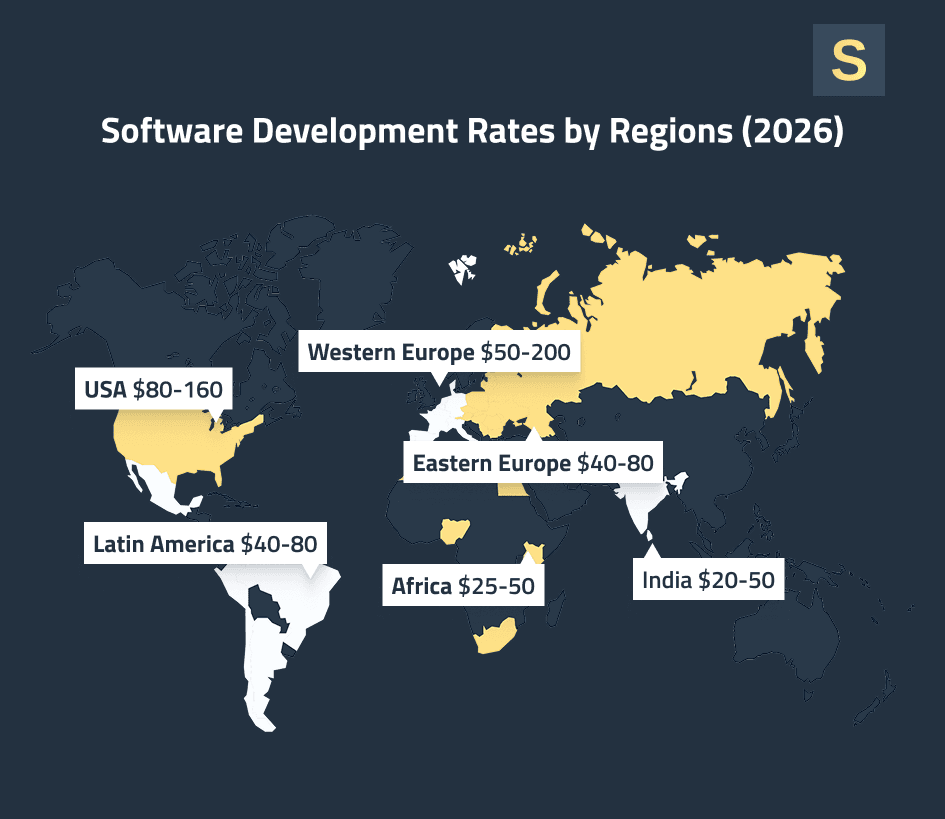
In 2026, software developer rates generally range from $20 to $200 per hour, with the U.S. and Western Europe offering the most expensive options.
Factors Affecting the Cost of Hiring a Software Developer
The cost of hiring a software engineer in 2026 depends on multiple factors, such as geographic location, tech stack, experience level, and engagement model. Let’s discuss each of them.
Geographic Location
Location differences can change rates by 5-10 times. A developer's compensation is largely dictated by the local cost of living (COL) and regional market demand. In high-cost metro areas like San Jose or New York, median salaries exceed $145,000. Yet, when adjusted for the COL index, the actual purchasing power is often lower than in emerging hubs.
So, here are the offshore software development rates by country according to GoodFirm’s 2026 Software Development Cost Research Survey.
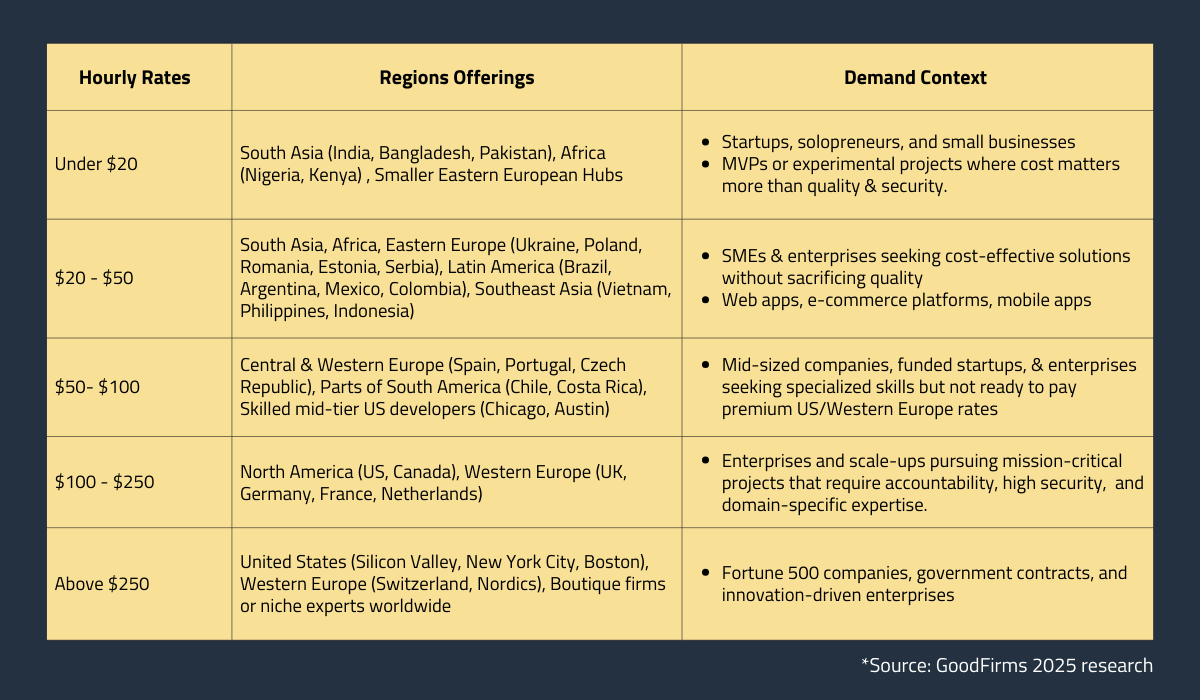
The sticker price of development remains high in traditional centers. At the same time, the global average for outsourced or augmented talent has settled into a range of $25 to $100 per hour. However, the median hourly rate for software development companies specifically in the United States and Canada has stayed firm at $100–$250. This fact reflects the high costs of business operations and local competition for talent.
In contrast, we see the emergence of nearshore sweet spots with software developers for hire, such as Mexico and Colombia for U.S. companies, and Estonia or Ukraine for Western European firms. This allows companies to balance time-zone alignment and cost efficiency.
Technology Stack
The price of certain skills is greatly affected by supply and demand dynamics. It's easier to find developers who work with widely used technologies, like popular web or mobile stacks. This keeps rates pretty stable.
However, projects requiring niche or high-impact expertise, such as AI engineering, cloud architecture, cybersecurity, or blockchain, tend to cost more.
Developer’s Expertise
Senior and full-stack developers typically charge higher rates than junior developers. However, hiring a full-stack developer is often the more practical choice for businesses as it reduces the need to pay for multiple specialists. A single developer who understands the entire system can also maintain consistency in architecture and quickly resolve issues that span multiple layers of the application. Although their hourly rate may be higher, the overall cost is often lower.
Length of Commitment
How you set up cooperation is a big part of pricing:
- Hiring quickly or for a short time usually costs more because vendors have to allocate resources and take on the risk of hiring.
- Long-term contracts usually come with lower monthly rates because they give both sides stability.
- Full-time allocation is usually cheaper than part-time because usage is more predictable.
Companies that plan for longer periods of working together often save money.
Engagement Model
The engagement model you choose directly affects the overall cost of software development by shaping how work is priced, managed, and delivered.
- A fixed-price model offers budget predictability but often includes risk buffers and extra fees for scope changes, which can raise the total cost.
- Time & Materials provides flexibility and lets you pay only for actual work done, making it more cost-efficient for evolving projects.
- Dedicated teams involve a steady monthly investment but improve efficiency over time, making them cost-effective for long-term development.
- Staff augmentation allows companies to add specific expertise without recruitment costs, but it relies on internal project management.
Vendor's Value Proposition
The cost of outstaffing includes more than just paying the developers. A big part of it goes to operational infrastructure, like:
- Finding talent and checking their technical skills
- Managing HR and payroll
- Providing contracts and regulatory compliance
- Supporting IT equipment and the workplace
- Managing delivery or account support
Vendors that have well-established processes, strong employer brands, and retention programs tend to charge higher margins. However, they also lower hiring risks and administrative costs for clients.
How Much Does It Cost to Hire a Front-End Developer?
Front-end development in 2026 has transitioned from simple interface coding to client-side systems engineering. The rise of sophisticated frameworks and the need for high-performance, accessible web applications have sustained the demand for specialized front-end talent.
In the United States, senior front-end developers earn a median salary of $145,000, while their counterparts in Poland or Serbia may earn between $45,000 and $65,000. This geographic arbitrage is a primary reason why startups frequently outsource front-end work, as the visual nature of the output makes it easier to manage remotely compared to complex back-end logic.
The debate React vs Angular continues to impact market rates:
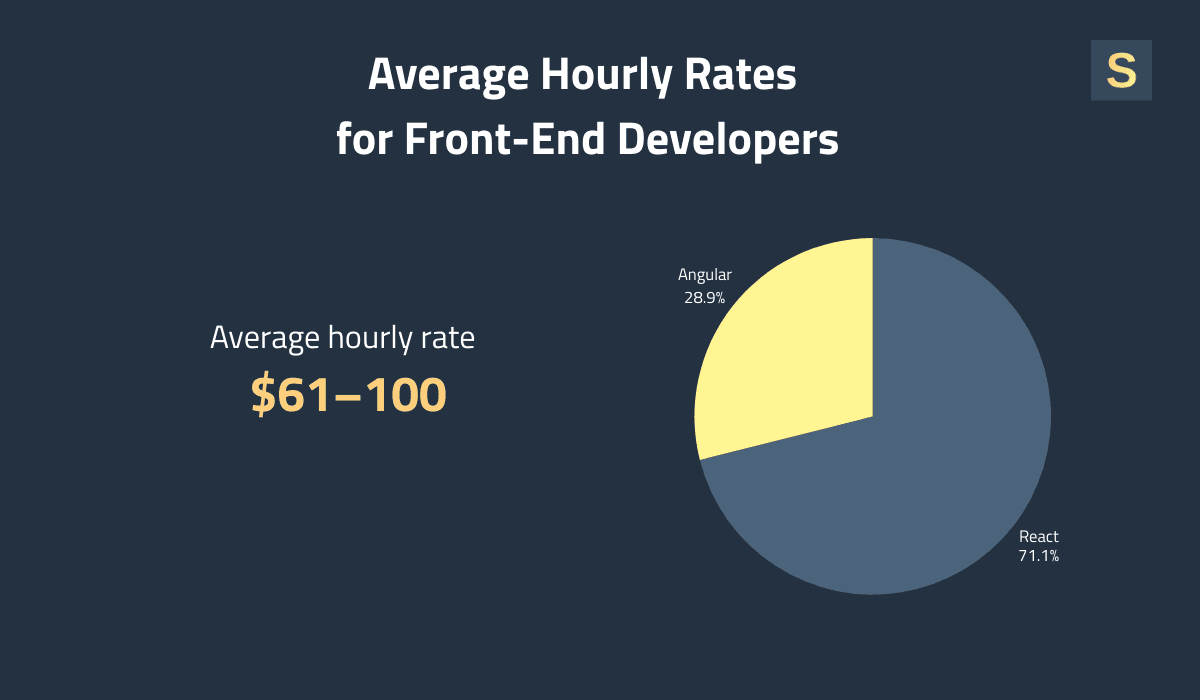
React remains the most popular choice, with its ecosystem of Next.js and Tailwind CSS driving mid-level rates to $30–$60/hr in nearshore markets. Angular, often preferred for large-scale enterprise projects with strict structural requirements, commands similar or slightly higher premiums due to the relative scarcity of senior-level experts compared to the vast React talent pool.
According to the Stack Overflow 2025 survey, 44,7% of respondents use React and 18,2% use Angular. That is a big difference, which also influences development costs, as talent availability, market demand, and the learning curve for each framework directly affect hourly rates and project timelines.
How Much Does It Cost to Hire a Back-End Developer?
Back-end developers remain among the highest-paid professionals in software engineering, with U.S. median salaries reaching $175,000. This premium is justified by the complexity of server-side operations and database management, as well as the increasing need to integrate AI models into existing data pipelines.
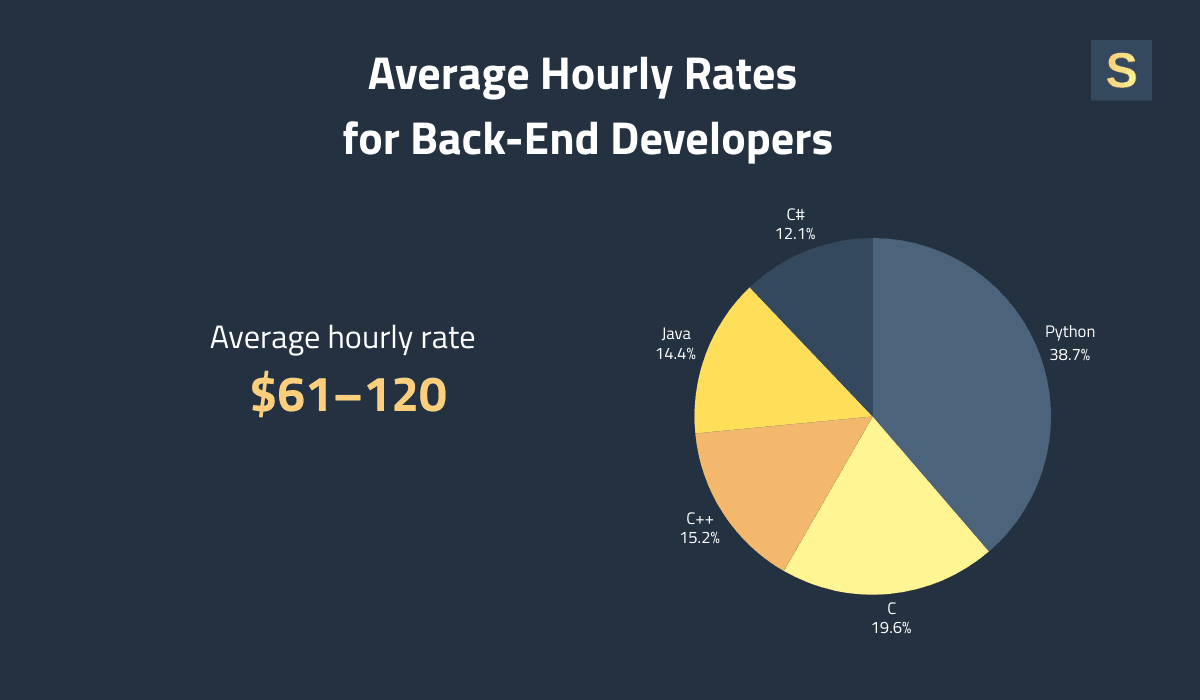
Back-end costs are heavily influenced by the hidden work of scalability and security. In 2026, a back-end engineer is often expected to act as a DevOps or Cloud Engineer. This expert must manage the infrastructure upon which the code runs. According to statistics, mid-level back-end developers typically charge in the range of $61–120/hour, and only about 10% of mid-level developers can be hired for $41–60/hour.
Back-end development largely shapes software development budget, and this is especially true for SaaS development costs. Expertise in high-performance, AI-compatible languages, along with infrastructure requirements, often accounts for the largest portion of budgets.
Where to Find and How to Hire a Software Developer
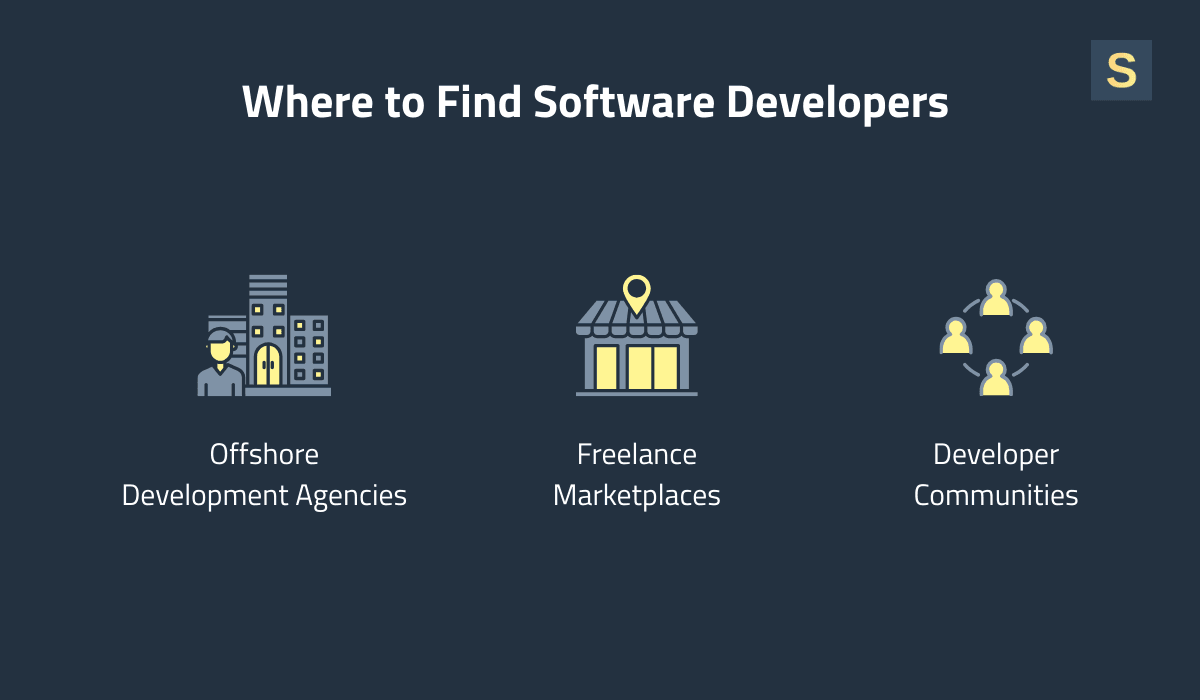
So, where to find a software developer in 2026? Today, SMBs and startups have three options. You can opt for the flexibility of freelancers, the accountability of agencies, and the long-term control of in-house teams. Let's discuss these options in detail.
Nearshore and Offshore Development Agencies
Agencies remain the most reliable partner for businesses that lack internal resources to vet and manage individual contractors. The primary advantage of an agency is its managed delivery model. For example, at Seedium, we can provide you with project managers, QA engineers, and architects who ensure the code meets professional standards.
Agencies typically provide performance guarantees and can replace a developer within 48 hours to 2 weeks if there is a mismatch. While hourly rates are higher than direct-hire offshore rates, the elimination of recruitment and infrastructure costs can provide up to 50% total cost savings.
Developer Communities and Direct Sourcing
Engaging with talent directly via GitHub or Stack Overflow allows founders to see actual code contributions and technical problem-solving. This method provides the highest technical competence. However, it offers the lowest reliability signal, as independent developers may juggle multiple projects.
Freelance Marketplaces
Marketplaces like Upwork and Toptal serve different ends of the quality-cost spectrum:
- Upwork. It is ideal for budget-conscious startups with small, well-defined tasks. Rates range from $20 to $100/hr, but the hidden cost is the time spent on screening. It can take months to find the right candidate.
- Toptal. It focuses on the "top 3%" of talent with rates from $100 to $200+/hr. They use a manual matching process that saves time but adds a significant markup (estimated 30-50%) on the developer's actual rate.
The choice between building an in-house team, hiring freelancers, or partnering with an agency is a strategic decision that affects both the budget and the risk profile. Many startups find that the IT agencies vs freelancers debate is resolved by the need for accountability.
While freelancers may offer lower headline rates, agencies provide a guaranteed delivery model with pre-vetted talent. One-third of clients approach us after working with freelancers, realizing they need more reliable, scalable teams to meet project deadlines and maintain code quality.
Hidden Costs and Mistakes to Avoid When Hiring a Remote Software Developer
The true cost of hiring a software developer extends beyond salary to include the friction of remote collaboration and the long-term impact of technical debt. Identifying these pitfalls early is important for maintaining a lean budget.
The Productivity Drag of Communication Overhead
In distributed teams, communication sprawl can quietly consume 25-30% of a team's productive capacity. This occurs when project requirements are unclear, leading to correction cycles and rework. Furthermore, 30% of all cloud spending is classified as waste, often due to forgotten test environments or redundant databases maintained by remote teams without oversight.
We recommend defining requirements in detail before development starts and keeping them in a shared, always-updated workspace. To prevent message overload, establish communication rules such as:
- Asynchronous updates
- Defined response times
- Ownership for each task
Pair this with regular cloud cost reviews and automated shutdown policies for unused environments. This way, operational waste will not accumulate alongside communication inefficiencies.
The Cost of Poor Integration and Culture Fit
Hiring solely for cost savings often leads to high churn. The cost to replace a developer can reach 150% of their annual salary when accounting for lost momentum and re-hiring fees. Developers who are treated as extra hands rather than strategic partners are more likely to leave. This creates a cycle of knowledge transfer risk that can stall critical project milestones.
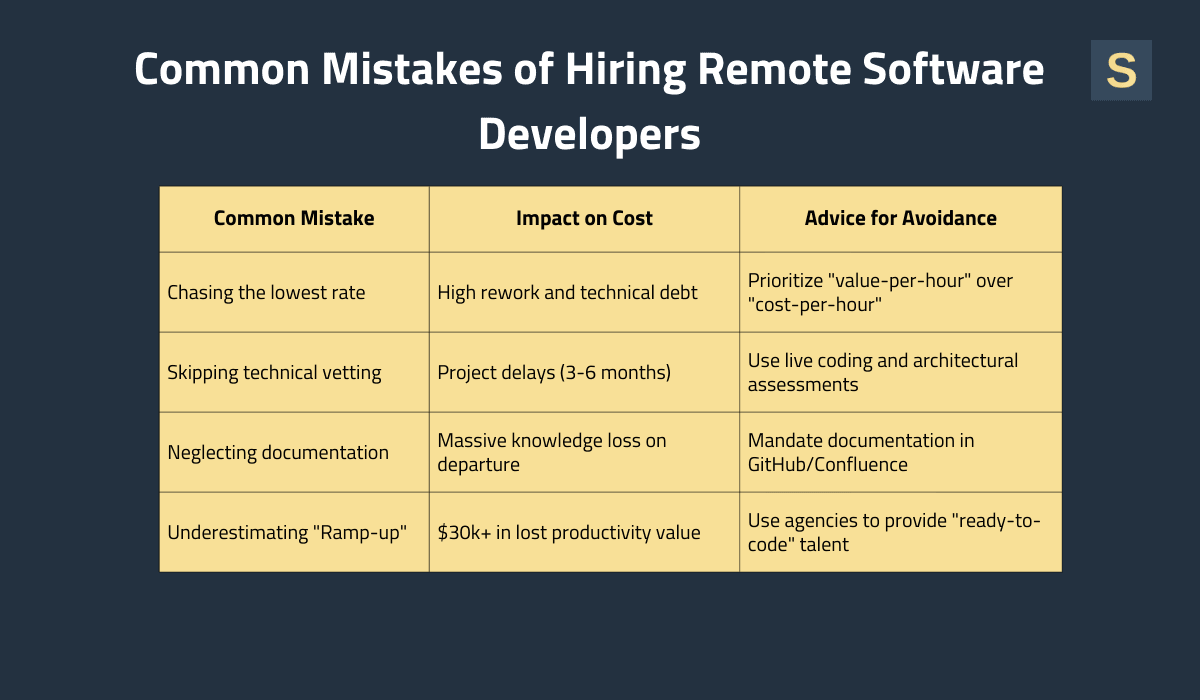
We recommend creating a structured ramp-up plan with clear milestones, documentation standards, and mentorship. Making documentation part of the delivery process reduces dependency on individuals and protects project continuity. This approach minimizes productivity loss if team composition changes.
The AI Tooling Surprise
According to a recent poll, American professionals are integrating AI into their work at an unprecedented rate. Adoption is highest in technology fields. Many organizations underestimate the resource-intensive nature of AI. Transitioning from a pilot to production-grade AI can significantly increase the total cost of ownership. This occurs mainly due to the costs of GPU cloud rental (approximately $1.53–$2.63/hr) and the need for continuous model retraining.
Before scaling beyond a pilot, we recommend you build a simple cost model that includes:
- Computing
- Storage
- Monitoring
- Retraining
Start with smaller models or usage caps to validate ROI. Then scale gradually based on real usage data. Establish MLOps practices early (versioning, evaluation, cost monitoring) so performance improvements don’t silently inflate your cloud bill.
Hire Software Developers from Seedium to Build Your Product with Confidence
Seedium provides dedicated development teams and team augmentation services for businesses seeking proven talent for their projects. Since 2017, we’ve been working with startups and SMBs across the EU, U.S., UK, Australia, and New Zealand. Over 60% of clients return to us for a second project, reflecting the quality and reliability of the teams provided.
Hourly rate: $25 - $49/hr Rating on Clutch: 4.9 Rating on Upwork: 100% Job Success Score
Seedium engineers bring commercial experience across more than 15 industries and are highly skilled in modern frameworks and AI-assisted development. Whether you need a single developer or designer or a cross-functional development team, we can quickly match you with the right candidates from our in-house talent pool. Use the form below to share your project requirements and request the specialist best suited to your needs.


