


- Key elements of AI agents include LLMs, contextual memory, functions, tools, and routing capabilities.
- Developing AI agents involves aligning use cases with business objectives, selecting the right tech stack, preparing and structuring data, designing the agent’s logic, implementing memory and context management, and ensuring thorough testing, deployment, and ongoing monitoring.
- The main challenges in AI agent development include response inconsistency, complex integrations, cost management, security and compliance, and stability in multi-step reasoning.
In this guide, you will find a step-by-step process for developing AI agents, along with real-world examples, challenges, and best practices.
How Do AI Agents Work?
AI agents work on top of large language models (LLMs) and interact with external tools and APIs to learn and improve. They store past interactions in memory to maintain context over time, personalize responses, and improve decision-making.
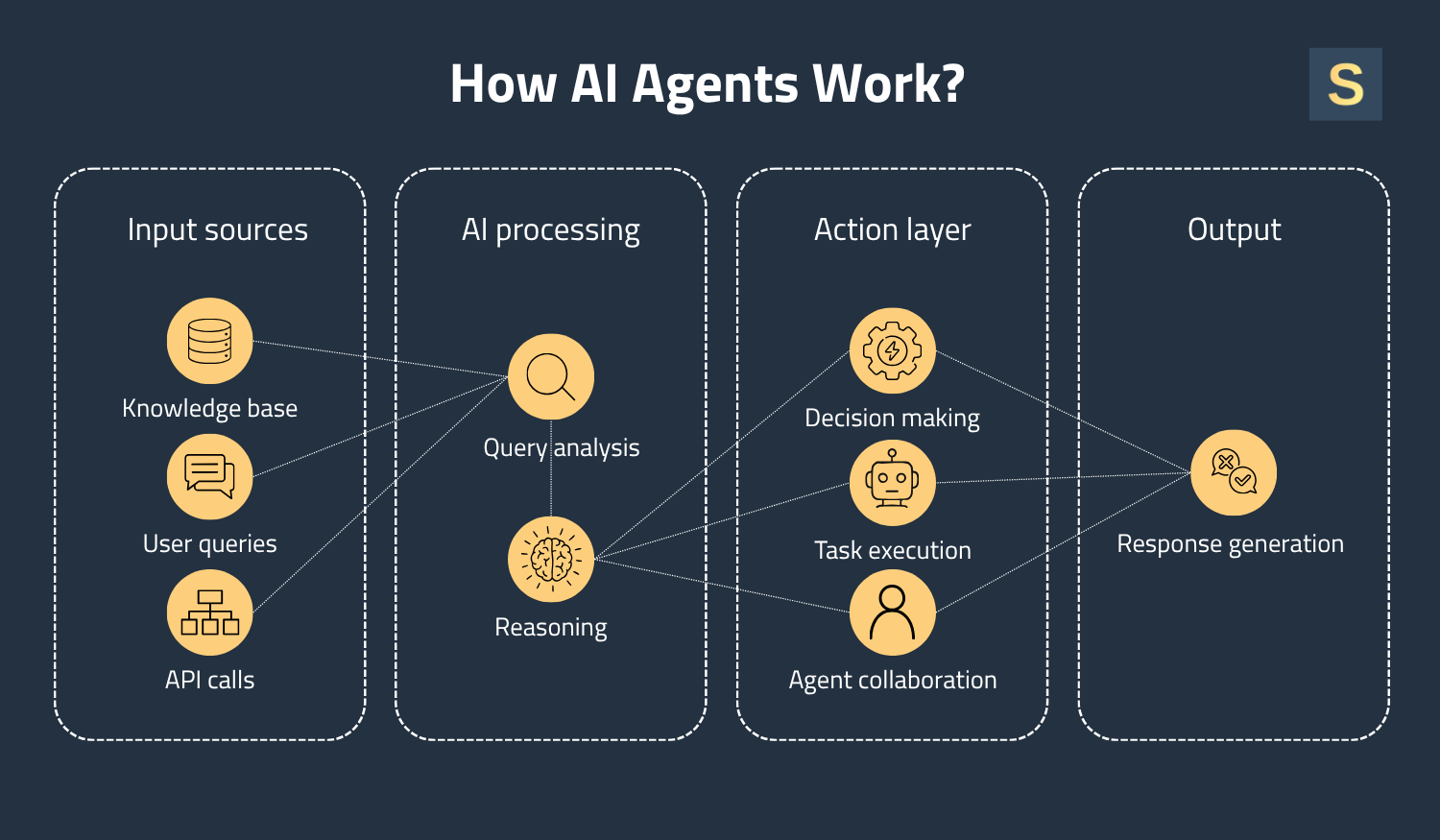
The key characteristics of AI agents include the following:
- Autonomy: they make decisions and take actions without human intervention
- Perception: they understand the context by processing inputs from text, images, audio, or system states
- Decision-making: they apply reasoning to act and achieve specific objectives
- Learning: they improve their decisions based on outcomes and observations
Unlike AI chatbots, which handle simple interactions, AI agents can independently plan, coordinate, and execute multi-step workflows to complete complex tasks.
Types of AI Agents for Business
There are different types of AI agents based on their purpose and functionality. Each type is designed to handle a specific level of complexity and requires different levels of logic, data, and resources.
- Rule-based agents operate using predefined “if-then” rules. They react directly to inputs based on fixed logic without learning or adapting. This option works for simple tasks such as system alarms and spam filtering.
- Goal-oriented agents can plan sequences of steps to reach a specific goal. This is a perfect fit for planning and navigation tasks.
- Learning agents continuously update their performance based on user interactions and new data. They are highly flexible and are used in complex workflows such as personalized recommendations.
- Utility-based agents evaluate multiple possible outcomes and choose the one with the best overall value. They are used in complex decision-making scenarios with trade-offs between multiple factors. This includes supply chain optimization or resource allocation.
- Multi-agent systems include several agents that communicate with each other to break down complex tasks into subtasks. These systems rely on AI orchestration to coordinate agent roles and ensure efficient task execution.
When building an AI agent for your business, you need to understand what type of solution fits your use case. This helps avoid overcomplicating development and optimizes resource use.
For example, a rule-based agent may be sufficient for handling simple customer support queries, while a learning or goal-oriented agent would be more appropriate for automated sales workflows.
Key Components of AI Agents
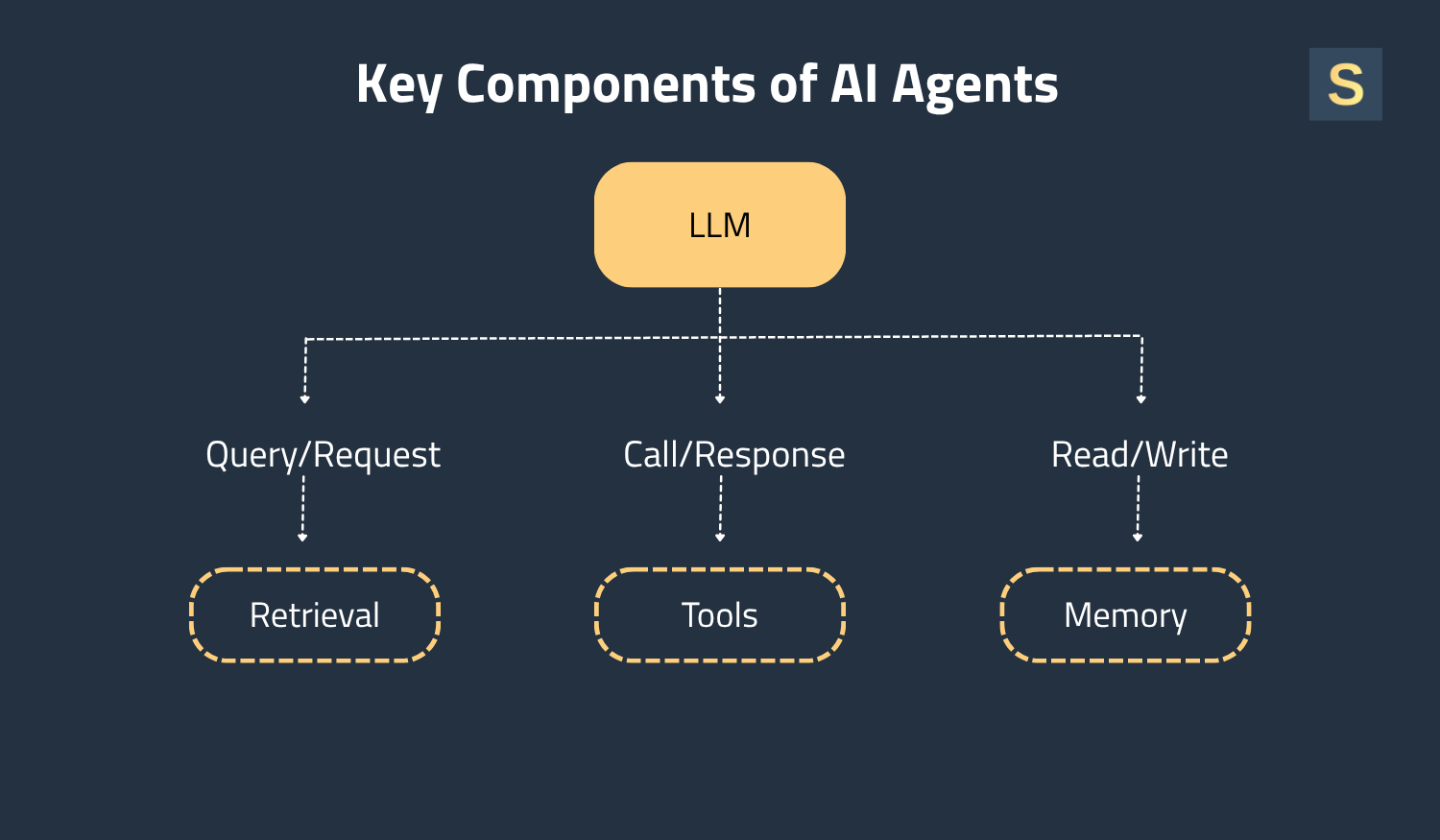
AI agents have three key architectural components:
- LLMs
- Contextual memory
- Functions, tools, and routing capability
LLMs
Large language models act as the brains of agentic systems. They take user input and generate a structured plan outlining the sequence of actions required to achieve the user’s goal.
Contextual Memory
This is a layer where information about the previous agent’s operations is stored. AI agents use short-term and long-term memories to improve performance and user experience.
Short-term memory is limited within a single session context. Its main goal is to keep an ongoing conversation and provide relevant outcomes to the user within the current interaction.
Long-term memory allows agents to learn over time and maintain persistent experience across sessions. It’s usually backed by vector databases or structured storage.
Functions, tools, and routing capabilities
Integration with other tools and systems is a crucial part of developing an AI-based agent. This includes databases, business services (CRM, ERP), code execution environments, etc.
Functions define what the agent is allowed to do in a structured way. The routing layer selects the appropriate tool or function based on the user’s intent and current context.
Together, they work in a continuous flow where the model interprets the request, the routing layer determines the best action path, and functions execute the required operations.
How to Create an AI Agent for Business: Step-by-Step Guide
Creating AI agents that provide real value requires a combination of strong business planning and deep technical expertise. Let’s break the AI agent development process into clear, practical stages.
1. Define Business Goals and Use Cases
The main secret of successful AI implementation is to start with a clear, narrow business goal. Many begin mapping out the features of AI agents instead of defining the specific problem to solve. This is a big mistake.
First, identify which manual processes within your team would genuinely benefit from automation. This could be repetitive data entry, routine customer support inquiries, report generation, etc.
Next, check whether the process can be effectively handled by an AI agent: if it has clear steps, available data, and predictable outcomes.
Finally, evaluate whether you actually need a full agent or if a simpler bot would be enough to solve the problem. For example, a simple chatbot can handle FAQ responses or password resets, while a full AI agent may be needed for processing multi-step customer requests by coordinating between systems.
2. Choose a Tech Stack
If you have decided to move on with AI agent development, it’s time to choose the right tools to build and deploy your solution. The choice greatly depends on the type of agent you want to build and the level of complexity it needs to handle.
| Layer | Purpose | Common Options |
| Intelligence Layer | Core reasoning, language understanding, and decision-making | OpenAI (GPT-4.1/GPT-5 class), Anthropic Claude, Google Gemini, Llama (via Hugging Face, Ollama) |
| Orchestration Layer | Manages agent flow, tool use, and multi-step reasoning | LangChain, LlamaIndex, Semantic Kernel, custom Python orchestration |
| Integration Layer | Connects agent to external systems (APIs, services) | REST/GraphQL APIs, internal microservices, Zapier, Make, custom SDKs |
| Memory Layer | Stores short-term and long-term context | Pinecone, Weaviate, FAISS, Chroma, PostgreSQL (structured memory) |
| Back-end Layer | Runs agent logic and exposes services | Python (FastAPI, Flask), Node.js (NestJS, Express) |
| Data Layer | Structured data storage and state management | PostgreSQL, MySQL, MongoDB, Redis |
| Infrastructure Layer | Deployment, scaling, and runtime environment | Docker, Kubernetes, AWS, GCP, Azure, serverless (Lambda) |
| Observability Layer | Logging, tracing, and debugging agent behaviour | LangSmith, OpenTelemetry, Prometheus, Grafana |
| Evaluation Layer | Testing quality, accuracy, and reliability | RAGAS, custom eval pipelines |
| Front-end Layer | User interaction with the agent | React, Next.js, Streamlit, chat UIs |
For the core intelligence layer, most software developers use a large language model API such as OpenAI or Anthropic.
For orchestration, you typically need a framework that manages agent workflows, tool use, and multi-step reasoning. Common choices include LangChain, LlamaIndex, or a lighter custom Python-based orchestration if you want more control.
For memory and data storage, vector databases like Pinecone, Weaviate, or FAISS are used for semantic memory, while traditional databases like PostgreSQL handle structured data and state.
For back-end infrastructure, Python is the dominant choice due to its AI ecosystem, with FastAPI or Flask being commonly used for serving agent APIs. In production setups, Docker and Kubernetes are often added for scalability.
However, low/no-code AI agent development platforms are often the best starting point to avoid complex development processes.
3. Prepare Your Data
Data is the fuel for your AI agent, on which the quality of outcomes depends. So, make sure your datasets are clean, up-to-date, and consistent. In practice, this often means preprocessing work such as removing duplicates, eliminating outdated records, standardizing labels, date formats, and naming conventions. Modern agentic data intelligence platforms can significantly simplify this stage by automating much of the cleaning, structuring, and integration process.
4. Build Core Agent Logic
To create an agentic AI workflow, you need to decompose the process into a clear sequence of steps that an agent can follow to reach the desired outcome.
For example, to process a customer refund request in an e-commerce system, the workflow can be broken down into steps such as:
- Identify the user’s intent
- Verify the customer and locate the order in the CRM
- Check refund eligibility based on policies
- Determine the appropriate action (full refund, partial refund, or rejection with explanation)
- Execute the operation in the payment system and update the order status
- Generate a confirmation message for the customer
Now, let’s turn it into a clear system logic. A typical AI agent workflow can be implemented as an event-driven pipeline with clear control flow:
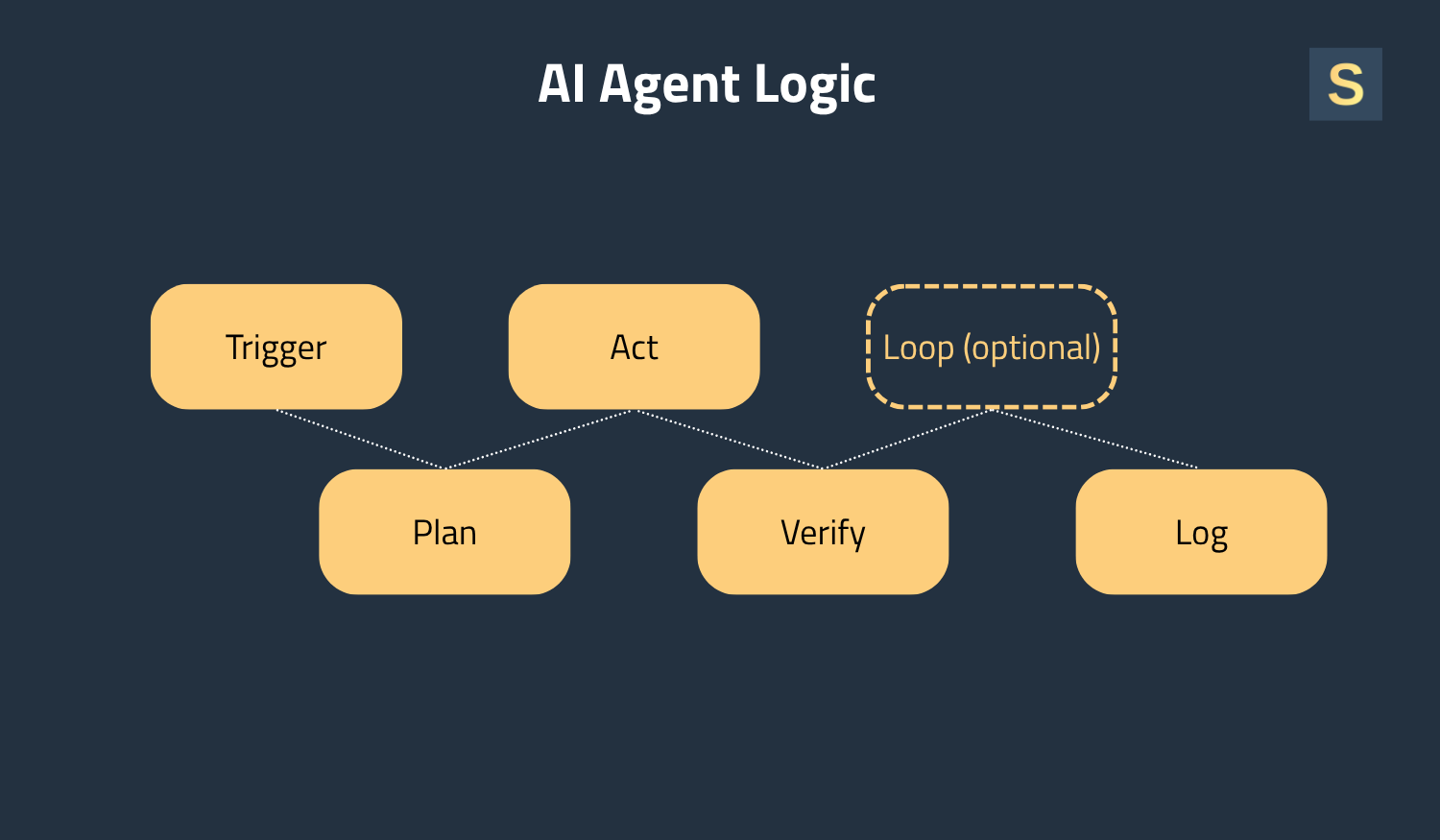
- Trigger Layer: The workflow starts from an external event, such as a user message.
- Planning/Reasoning Layer: The agent processes the input using an LLM to interpret intent, construct context, and generate a structured execution plan (often in JSON or function-call format).
- Execution Layer: The orchestrator executes the planned steps by calling external services and APIs (e.g., databases, CRM systems, payment gateways, etc.).
- State & Verification Layer: Each tool response is validated against expected schemas or business rules.
- Control Layer: If validation fails or new information changes the context, the agent re-enters the planning stage to adjust the execution path or retry specific steps.
- Observability Layer: All steps, including prompts, tool calls, responses, errors, and decision points, are logged and traced for debugging, evaluation, and performance monitoring (often via OpenTelemetry or similar systems).
From there, you can build the key elements of your agentic system.
5. Implement Memory and Context Management
At this step, you need to implement how the system uses information beyond a single interaction to produce more consistent performance over time.
In practice, this often includes a context window manager that prepares inputs for the LLM, a storage layer such as a database or vector store for long-term memory, and a retrieval mechanism that surfaces the most relevant information based on similarity or rules.
The key challenge is to ensure the agent has enough context to make informed decisions without overwhelming it with irrelevant or outdated data. One of the solutions is to store long-term data externally, then only pull back relevant pieces based on similarity search (embeddings) and simple filters like time or type.
6. Test and Refine
After all the above, it’s time to ensure that the agent provides the results you expect. Define key test scenarios based on real user tasks. Verify that the agent calls the right APIs, sends correct parameters, and handles failures. This way, you will test not only reasoning but the full workflow.
Finally, run regression testing continuously, especially after prompt changes or model updates, to ensure behaviour doesn’t degrade over time.
7. Deploy and Integrate
Once everything is tested and verified, you can deploy an AI agent to production. A key part of this phase is defining clear interfaces between the agent and external systems. This includes authentication, rate limits, input/output schemas, and error handling to ensure predictable and secure interactions.
Best practices also include introducing monitoring, logging, fallback behaviour, and human-in-the-loop escalation for sensitive or uncertain actions.
That’s it. Your AI agent is ready!
Agentic AI Case Studies
Let’s see what the AI agent development process looks like using examples of real projects we worked on.
Agentic AI in Healthcare Case Study: AllClinics Agent
Project description: AllClinics is a healthcare market intelligence platform that aggregates data on all licensed medical organizations in the U.S.
Seedium was responsible for the end-to-end development of the product, including the customer support chatbot. Later, we were tasked with turning the chatbot into a full-fledged AI agent to help the client fully automate support of the platform’s users.
Challenges:
- Implement agent-based architecture without disrupting existing functionality
- Reduce AI hallucinations to provide reliable outputs
- Maintain consistent response time and output quality as user load increases.
Solutions:
- We successfully migrated all assets from the initial Botpress architecture to a new RAG-based system using APIs and custom scripts. This helped us preserve existing resources and optimize development time and cost.
- The system retrieves answers from vector-indexed documents, reducing hallucinations and improving accuracy. A policy layer enforces rules from Privacy-Policy.txt, including blacklists, topic limits, and PII masking.
- To ensure system scalability, we used the Milvus database, which allows us to dynamically add replicas and nodes under load.
Results:
The implemented solutions and approaches allowed us to create a reliable AI agent that helped the client automate customer support with 24/7 availability. This led to approximately 85% of issues being resolved without human intervention.
Agentic AI for Document Generation Case Study
Project description: It’s an NDA project we worked on to build a complex multi-agent system for generating business documents from the user’s prompt.
Challenges:
- Designing reliable coordination between agents
- Ensuring factual consistency across generated outputs
- Maintaining high standards of quality and security throughout the system
Solutions:
- We built a system of specialized AI agents, where smart routing sends each task to the most suitable agent. All generated documents are stored and converted into embeddings, so agents can quickly retrieve only the relevant information using a RAG-based approach.
- Each agent’s output goes through a strict control loop that checks it against predefined rules and structured schemas. A dedicated review agent then evaluates the result and refines it when needed to ensure accuracy and quality.
- The memory is continuously updated after validation, allowing the system to improve.
Results:
After testing and validation, the system demonstrated more than 90% task completion rate, with the potential to accelerate document generation by 2–5× compared to manual processes. The product is now in the pre-launch stage.
“In our system, each agent is implemented as a single LLM call with a clearly structured input and a strong system prompt. Each subsequent agent builds on the results of the previous one. This approach allows for stable behaviour, fast response, and simple control.”
Dmytro Machulianskyi, Full-Stack Developer at Seedium
Challenges and Best Practices for AI Agent Development
Despite the growing number of no-code platforms and guides discussing how to build AI agents, developing production-ready agentic systems remains a complex task. Let’s explore the key challenges and practical ways to address them.
Consistency of Responses
Challenge: The thing with LLMs is that they can give different results for the same query. This creates challenges for consistency, predictability, and overall user experience.
Solution: Most developers see fine-tuning as the primary solution to inconsistency in LLM outputs, but in reality, it’s often a costly, complex, and slow process.
In our experience, a well-designed combination of prompt engineering, structured outputs, and clear system constraints can significantly improve reliability from the start. Spending time on better prompts, clear formats, and simple validation helps you get more consistent results and improve the system faster.
Integration Complexity
Challenge: AI agents often rely on third-party tools and external systems, which introduces integration complexity. This happens due to inconsistent data formats, API failures, rate limits, and authentication issues. Solution: Address this by introducing a dedicated integration layer that standardizes all external interactions. This layer should normalize data formats, manage authentication securely, handle retries and rate limits, and provide consistent error handling. Using clear API contracts and isolating external dependencies behind tool interfaces also helps make the system more stable, predictable, and easier to maintain.
Cost Management
Challenge: Running AI agents at scale can lead to high and unpredictable costs due to frequent LLM calls, tool usage, long context windows, and external API dependencies. Solution: A good practice is to reduce unnecessary calls through better caching and batching, and limiting context size with effective memory management. Additionally, implement usage monitoring, budget alerts, and routing logic that selects the most cost-efficient model or tool for each task.
Security & Compliance
Challenge: Deploying AI agents in production requires meeting security and compliance regulations, especially in industries such as healthcare, fintech, and manufacturing.
Solution: To address this challenge, you should establish strong guardrails around data access and model outputs by restricting sensitive information handling. Also, apply role-based access control, and use structured, policy-driven outputs wherever possible.
In addition, implement logging and audit trails for all agent actions, ensure data encryption in transit and at rest, and design a human-in-the-loop approval for high-risk operations.
Poor Multi-Step Reasoning Stability
Challenge: Autonomous agents sound like a dream, but in practice, it’s still hard to achieve. These systems often fail on multi-step tasks, where they lose track of goals and make inconsistent decisions across steps. Solution: Try to break tasks into smaller, well-defined steps and enforce a structured planning phase before execution. Use a controlled orchestration layer to manage step-by-step progress, and add validation checkpoints between steps.
Rely on Seedium to Build AI Agents for Your Business
If, after reading this AI agent development guide, you feel that you need the assistance of experienced engineers to optimize your workflows and budgets, feel free to contact us.
With 200+ successfully delivered projects across 15+ industries, our team has extensive expertise in building innovative solutions that deliver real business value. Whether you need end-to-end AI agent development services or want to hire experienced AI engineers to augment your team, we can support your needs.
Contact us using the form below to discuss your project requirements and get started.


