


- Core skills to look for in remote back-end developers include proficiency in modern programming languages and frameworks, strong knowledge of databases, experience in building scalable architectures and APIs, and familiarity with DevOps practices.
- Common ways to source back-end developers include freelance platforms (Upwork, Fiverr, Toptal), tech communities (Reddit, Stack Overflow), and outsourcing companies.
- Typical back-end developer rates range from $20 to $350 per hour, depending on experience, region, tech stack, and hiring model.
Hiring remote back-end developers for your project can be a tough process. One mistake could cost you time and lead to budget overruns and even put your product's success at risk if critical architectural decisions or code quality fall short.
This guide is designed to help you make the right decision, outlining the essential back-end competencies to evaluate, typical cost considerations, and proven best practices for building a strong remote team.
Benefits of Hiring a Remote Back-End Developer for Your Project
Let’s start by understanding how hiring remote back-end engineers can benefit your product development and why businesses opt for this option.
The key advantages of hiring remote back-end developers include:
- Access to a global candidate pool: You can hire from anywhere in the world. This often allows businesses to find experienced developers at affordable prices. This is especially beneficial if your local talent market is limited.
- Cost-efficiency: Beyond the advantage of varying developer rates across global markets, remote hiring also reduces costs such as office space, equipment, insurance, and employee benefits.
- Scalability: Remote hiring allows you to add developers faster without going through long recruitment processes. It also allows you to engage specialists on a project or per-task basis without long-term commitments.
- Faster adoption of innovation: Remote hiring gives you access to specialized expertise in emerging technologies such as AI, ML, and blockchain. These skills can be difficult and expensive to build in-house. As a result, you can implement new solutions more quickly and stay ahead of technological advancements.
- Accelerated product development: All of this contributes to faster development cycles, allowing you to bring products to market more quickly and respond more effectively to changing business needs.
Of course, remote hiring has its trade-offs, including communication challenges across time zones, reduced real-time collaboration, and the need for stronger processes to ensure alignment, accountability, and consistent code quality.
However, for startups and businesses without a continuous pipeline of development work, remote engineers offer significant value by providing on-demand expertise without the need for maintaining a full-time in-house team.
Key Back-End Technologies Your Developers Should Know
The back-end tech stack is very broad, and each project may require specific competencies. However, there are common technical skills that a remote back-end developer should possess to create scalable architectures, robust integrations, and high-performance systems.
| Area | Technologies |
|---|---|
| Programming Languages | Node.js, Python, Java, Go, C# |
| Frameworks | Express.js, NestJS, Django, Flask, Spring Boot, ASP.NET Core |
| Databases (SQL) | PostgreSQL, MySQL, Microsoft SQL Server |
| Databases (NoSQL) | MongoDB, Redis, Cassandra |
| APIs | REST, GraphQL, gRPC |
| Authentication & Security | OAuth2, JWT, OpenID Connect |
| DevOps/CI-CD | Docker, Kubernetes, Jenkins, GitHub Actions |
| Cloud Platforms | AWS, Google Cloud Platform (GCP), Microsoft Azure |
Programming Languages & Frameworks
The choice of back-end programming language determines the system’s performance characteristics, scalability potential, development speed, and the availability of libraries, frameworks, and developer talent.
With the rise of AI, Python and Node.js have become the most popular options as they allow for seamless integration with modern AI, data processing, and cloud-based tools. Both languages integrate easily with cloud SDKs from AWS, Google Cloud, and Azure, enabling efficient deployment, scaling, and orchestration of AI models.
Databases
The choice of database influences how efficiently data is stored, retrieved, and scaled, as well as the system’s consistency model, performance under load, and ability to handle complex queries or unstructured data.
Choosing between SQL and NoSQL databases depends on your data structure, scalability needs, and how your application handles consistency and queries:
- SQL databases like PostgreSQL or MySQL are used when your data is structured, and relationships between entities are important.
- NoSQL databases like MongoDB or Cassandra are used when flexibility, scalability, and high-speed access are more important than a rigid structure.
Many modern systems use a hybrid approach, combining SQL for core transactional data and NoSQL for high-volume workloads.
APIs
Working with APIs is a core area of expertise for any back-end developer, as it directly influences the efficiency of communication between services and the front-end.
REST APIs remain the golden standard for most projects, but newer approaches such as GraphQL and gRPC are increasingly used to address specific needs like:
- more efficient data fetching
- real-time communication
- improved performance in microservices-based architectures
Authentication & Security
Your remote back-end developers must have proven expertise in implementing security mechanisms. This is especially important for highly regulated industries such as healthcare and fintech.
Security competencies include:
- secure authentication and authorization mechanisms
- protecting against common vulnerabilities such as SQL injection, XSS, and CSRF
- ensuring proper data encryption in transit and at rest
- following secure coding practices aligned with industry standards
Ensure that the developers you work with are well-versed in protecting applications against the OWASP Top 10 vulnerabilities and know how to ensure compliance with any regulatory requirements relevant to your project.
Cloud & DevOps
Working with back-end developers who have proven experience in building scalable infrastructure and managing hosting environments is essential, whether you already have a preferred cloud provider or need guidance in selecting one.
AWS, Google Cloud, and Azure are the leading platforms on the market, and the choice depends on your project’s specific requirements, scalability needs, and integrations with third-party tools or services.
Your engineers also need knowledge of deployment automation and container orchestration to ensure reliable releases and efficient resource utilization. This usually includes tools such as Docker for containerization, Kubernetes for orchestration, and CI/CD platforms like Jenkins, GitHub Actions, or GitLab CI for automating build, test, and deployment pipelines.
Essential Skills to Look for When Hiring Remote Back-End Developers
Besides the technical stack, back-end developers should also have a range of complementary skills that are essential for effective remote collaboration.
These include the following:
- Strong communication skills: Developers must be able to express technical solutions in a clear and accessible way that the entire team can understand. This applies to both verbal and written communication.
- Collaboration and teamwork: This includes not only soft skills but also proficiency with collaboration tools that simplify team communication and enable effective progress tracking. Examples include Slack or Microsoft Teams for communication, version control systems like Git, and platforms such as GitHub or GitLab for code management.
- Time management: On-time delivery requires high self-discipline from remote developers, the ability to make clear estimates and stick to them.
- Problem-solving: In software development, unexpected challenges frequently arise, requiring adaptability, resilience, and the ability to perform effectively under pressure.
- Documentation discipline: Clear code comments, API documentation, and architectural notes help maintain continuity across teams and simplify product development and maintenance.
Many businesses underestimate soft skills and cultural fit, even though these factors directly impact the ease and effectiveness of collaboration with remote developers. Make sure to prioritize communication style and alignment with your team’s working practices when evaluating candidates.
Where to Find Back-End Developers
There are several ways you can hire remote back-end developers. Each approach offers benefits and trade-offs, so you need to decide what’s most important to you.
| Criteria | Freelance Platforms | Community Platforms | Outsourcing Companies |
|---|---|---|---|
| Talent quality | Highly variable | Often high, but inconsistent | Generally pre-vetted, consistent standards |
| Cost | Low to medium | Low to medium | Medium to high |
| Speed of hiring | Fast | Moderate | Fast to moderate |
| Reliability & accountability | Low to medium | Low to medium | High |
| Scalability | Limited | Limited | High |
| Management effort | High | Medium | Low |
| Risk level | High | High | Low |
Freelance Platforms
Talent marketplaces such as Upwork or Fiverr offer access to thousands of developer profiles from around the world. You can evaluate candidates based on their tech stack, completed projects, and feedback from previous clients.
The primary advantage of hiring freelancers through these platforms is cost efficiency, as rates are often lower compared to outsourcing companies.
However, this approach comes with certain risks, particularly around quality and reliability. There is limited assurance that a freelancer will remain consistently available or that their deliverables will fully meet your standards.
This model is best suited for small-scale projects or well-defined tasks where potential issues wouldn’t significantly impact the overall product.
Community Platforms
Communities such as Reddit, Stack Overflow, or Indie Hackers provide an alternative channel for finding motivated engineers for your projects. In some cases, you may also connect with individuals open to working for equity or joining as co-founders.
The key advantage of this approach is direct, peer-to-peer interaction with potential candidates, which often allows for a quick assessment of mindset, motivation, and cultural fit.
However, the main challenge lies in validating technical expertise and ensuring reliable delivery, as formal vetting and contractual safeguards are often limited.
This option is particularly well-suited for early-stage products with constrained budgets and evolving teams.
Outsourcing Companies
The most reliable way to hire remote back-end developers is through outsourcing companies offering dedicated teams and team augmentation services.
They provide advantages such as:
- Proven talent pool with pre-vetted and experienced developers
- Easier scalability, as you work with an already established and structured team
- More consistent quality and accountability due to internal processes and team coordination
- Greater reliability, supported by formal contracts and the outsourcing company’s reputation
Among the trade-offs is a slightly higher cost, which is often offset by greater transparency in the development process and stronger delivery guarantees, resulting in reduced execution risk.
Cost of Hiring Back-End Developers in 2026
Rates for back-end developers vary significantly depending on geographic location and business-related factors. On average, hourly rates range from $20 to $350.
Average price of hiring back-end developers by region (Source: Flexiple)
| Region | Junior | Middle | Senior |
|---|---|---|---|
| North America | $35–$70 | $70–$130 | $120–$200+ |
| Western Europe | $35–$65 | $65–$120 | $110–$180 |
| Eastern Europe | $20–$40 | $40–$85 | $70–$120 |
| Asia | $18–$35 | $35–$70 | $60–$110 |
Factors influencing back-end development cost include the following:
- Experience level: Junior developers are more affordable but require guidance and supervision, while senior engineers charge higher rates due to their ability to design systems, solve complex problems, and work independently.
- Geolocation: Hourly rates for developers are largely determined by local market conditions and the overall economic environment, which is why prices vary significantly across regions. This allows businesses to hire experienced developers from overseas at more competitive rates. However, it’s important to keep in mind that high-quality development can’t come at a price significantly below market expectations.
- Tech stack: Niche specialists often command higher rates due to limited market availability. Experience with advanced domains such as AI and machine learning further increases their value. In addition, certain technologies may require paid licenses or specialized development tools, such as Microsoft Visual Studio Enterprise, when building with .NET.
- Type of cooperation: As we discussed, freelancers and outsourcing companies have different pricing structures. Companies tend to be more expensive but offer reliability.
Working with proven back-end developers helps optimize budgets and avoid costly mistakes. Moreover, experienced engineers know how to ensure faster development without compromising quality.
For example, at Seedium, we use AI-assisted engineering to streamline repetitive tasks and accelerate delivery. This approach combines AI-driven automation with the expertise and oversight of senior engineers, ensuring both efficiency and high-quality output.
Best Practices for Hiring Remote Back-End Developers
As you can see, there are numerous ways to source and hire remote back-end developers. This expands your reach, but also makes selecting the right fit more complex.
To navigate this effectively, you need a structured approach that goes beyond basic screening. The following best practices will help you reduce hiring risks and build a high-performing remote team.
Define Clear Requirements
Start by clearly defining the type of specialist your project requires. Each product demands a different mix of expertise beyond core programming skills. Maybe you’re developing healthcare software where security and compliance are top priorities, or building a SaaS application for which experience with multi-tenant architectures is crucial.
Prioritizing requirements will not only streamline your candidate evaluation process but also prevent costly mismatches, ensuring you focus on engineers whose experience aligns directly with your technical and business goals.
Use a Structured Technical Assessment Approach
A common mistake business owners make when hiring remote developers is approaching evaluation without a clear, pre-defined framework. Relying on claims or surface-level credentials instead of a structured assessment often leads to costly mis-hires.
Establish your own evaluation process that consistently validates both technical competence and real-world problem-solving ability. This can include tailored coding tasks, architecture discussions based on actual use cases, and practical scenarios that reflect the challenges your team faces. Combine this with a focused review of past work and reference checks.
Consider Cultural Fit
Alignment between a candidate’s working style, communication habits, and professional values and your organization’s culture is critical for effective collaboration, especially in a remote environment. When this alignment is strong, teams tend to communicate more clearly and resolve issues faster.
It’s hard to assess cultural fit during just a few calls, but it becomes much more reliable when you structure the evaluation intentionally. Instead of relying on general impressions, design conversations and exercises that reveal how a candidate thinks and works in practice.
Validate Real-World Remote Experience
Reviewing a candidate's previous experience is one of the most reliable ways to assess their expertise. Ask for a portfolio of delivered projects and focus specifically on work that is relevant to your use case in terms of complexity, scale, and technical requirements.
Go beyond surface-level descriptions and explore the candidate’s actual role in each project. Clarify what problems they solved, what architectural decisions they made, and what trade-offs they handled.
Following these best practices will help you choose the right candidate and strengthen your development team.
Hire Experienced Back-End Developers from Seedium
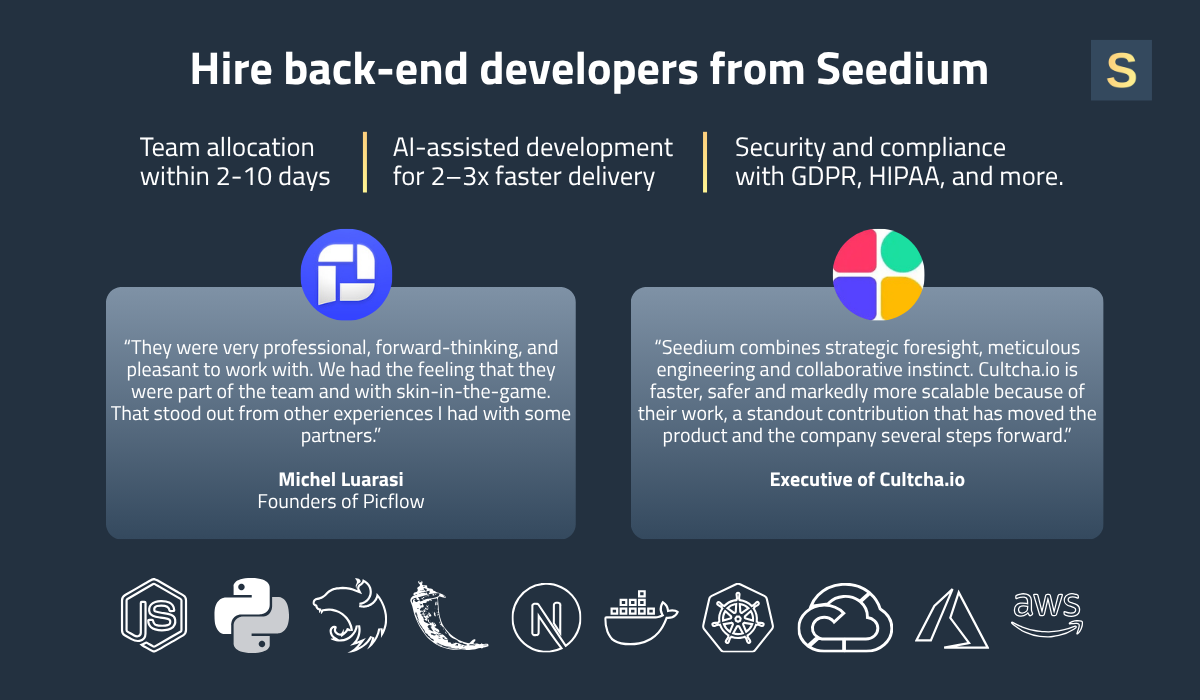
Seedium provides reliable dedicated teams and staff augmentation services that help businesses around the world build and modernize their digital products. Over the past 9 years, we’ve delivered 230+ projects and built a strong pool of pre-vetted in-house developers.
With our AI-assisted engineering approach, our specialists streamline the coding process by automating repetitive tasks while maintaining full ownership of the outcomes. Combined with solid experience in API design and scalable architectures, this ensures faster delivery without compromising quality and reliability.
Success Stories for Hiring Remote Back-End Developers
Seedium's back-end developers have contributed to the development and modernization of successful products in the global market. Check out some of the case studies and learn how we delivered value to our clients.
Picflow: Online Proofing Platform for Creatives
Our role: Seedium was responsible for designing a scalable back-end infrastructure for a collaboration tool, ensuring fast image uploads and downloads while preserving full resolution and maintaining performance at scale.
Impact: The result of our cooperation was a scalable application, featuring seamless integrations with authentication services, billing systems, marketing automation tools, and CRM platforms. Today, Picflow has 10,000+ registered users and successfully supports the growing load.
Learn more about the Picflow case study.
All-in-One SaaS Hiring Platform
Our role: Seedium helped an HRTech startup finalize and scale a hiring platform, turning the MVP into a multifunctional solution with a high-performing back-end capable of handling complex business workflows.
Impact: The platform was launched with major improvements in stability and scalability. It now reliably supports more than 200 hiring teams. Users consistently highlight its speed, cost efficiency, and flexibility.
Learn more about this case.


