


- Hiring remote front-end developers can be 1.5–3× cheaper than in-house teams and allows companies to start work within days instead of lengthy recruitment cycles.
- Core front-end skills include HTML, CSS, JavaScript, and TypeScript, plus frameworks like React, Angular, or Vue.
- Common sources for finding front-end developers include freelance platforms (Upwork, Fiverr, Toptal), tech communities (Reddit, Stack Overflow), and outsourcing companies.
- Typical front-end developer rates range from $15 to $120 per hour, depending on experience, region, and hiring model.
Hiring remote developers for short-term project needs has become an effective strategy for startups and small businesses to build successful products without the overhead of in-house teams. However, finding the right talent who not only meets your technical requirements but also delivers reliably can be challenging. This is especially true for companies new to outsourcing or those with less-than-ideal past experiences.
This guide will walk you through the whole process of finding and hiring front-end developers for your project, covering key aspects such as skills, rates, and collaboration.
Benefits of Hiring a Remote Front-End Developer for Your Project
Let’s start by understanding the key benefits of hiring remote developers and situations when it works best.
The key advantages of working with remote specialists include the following:
- Cost-efficiency: Statistics show that hiring a remote developer can be approximately 1.5–3× more cost-effective than hiring in-house. This advantage comes not only from reduced overhead costs, but also from more flexible engagement models and differences in global market rates.
- Faster hiring process: Remote engineers can often begin working on a project within a week. This is a strong alternative to lengthy recruitment processes that require additional time, cost, and effort for screening and expertise validation.
- Access to a global talent pool: You can hire from regions with more competitive rates and gain access to highly skilled specialists who may be difficult to find or afford in local markets. This approach significantly expands your talent pool, making it easier to find niche expertise or senior-level professionals.
- Flexibility and scalability: Remote teams scale up and down according to your needs. The greater benefit is that you can hire for specific tasks or timeframes instead of committing to a full-time role.
As a result, you accelerate time-to-value, avoiding bureaucratic processes and focusing only on progress.
Key Front-End Technologies Your Developers Should Know
While the exact tech stack depends on your project requirements, there are several core technologies that front-end developers are generally expected to know. Let’s break them down.
| Type | Technologies |
|---|---|
| Programming Languages | HTML, CSS, JavaScript, TypeScript |
| Frameworks & Libraries | React, Angular, Vue.js, Next.js |
| Styling Tools | CSS, Tailwind CSS |
| Data Communication | REST APIs, GraphQL |
Programming Languages
Front-end programming languages are the core building blocks. Small projects such as prototypes, MVPs, or simple websites are typically built with JavaScript, while more complex applications often rely on TypeScript for added safety and scalability.
However, many teams use both, since TypeScript ultimately compiles down to JavaScript. As a result, familiarity with both languages is a valuable advantage for front-end developers.
Frameworks & Libraries
These tools are used for building scalable, reusable, and efficient user interfaces. There are different frameworks, and their number is growing every year, but React, Vue, and Angular remain the most popular.
The choice between React and Angular is the most common case for production-grade applications. React is typically used for small to medium-sized projects, while Angular is used for more complex applications with strict security requirements.
Make sure to define which technology works best for your project since most front-end developers specialize in one primary framework.
Styling Tools
Tools such as CSS and Tailwind CSS are used to design layouts and manage styles. While CSS is basic in front-end development, Tailwind CSS is commonly used in modern projects (especially with frameworks like React) to build UIs faster and more consistently.
Data Communication
Front-end engineers should have experience working with modern APIs to enable seamless interaction between user interfaces and back-end systems. In practice, this means being able to consume and integrate services such as REST APIs or GraphQL.
While front-end developers are not typically responsible for building APIs, they should understand how client–server communication works, handle data formats like JSON, manage authentication flows, and deal with loading states or errors.
Essential Skills to Look for When Hiring Remote Front-End Developers
In addition to technical knowledge, front-end developers must also possess other skills important for building software products. They include the following:
- Communication: It’s an essential skill for any remote developer, reducing misunderstandings and enabling smooth collaboration across distributed teams. Make sure the developers you will work with can clearly express their ideas and ask clarifying questions when needed.
- Time management: Another crucial competence that helps deliver work on time by planning tasks and meeting deadlines. This is especially important if your team is distributed between different time zones.
- Familiarity with collaboration tools: Collaboration apps provide efficient teamwork, clearer communication, and smoother project coordination throughout the development lifecycle. This includes experience with tools for version control, such as Git and platforms like GitHub or GitLab for code review, as well as communication apps like Slack or Microsoft Teams.
- Cybersecurity awareness: Secure coding best practices are non-negotiable for any production-ready application. Validate a developer’s understanding of common security risks and their ability to prevent them in real-world scenarios. This includes proper input validation and sanitization, safe handling of user data, secure authentication, and authorization practices.
- Understanding the importance of UX: It’s crucial that front-end developers can do more than simply translate designs from Figma into code. They should also evaluate how the interface performs in real use, ensuring that users can navigate the product easily, understand its structure intuitively, and interact with it without friction.
Prioritize what skills are the most important for your project and company culture, and make sure to include them in the requirements.
Where to Find Front-End Developers
Once you have a clear portrait of the front-end specialist you need, you can proceed with the search. There are several options where you can actually find remote developers.
| Criteria | Freelance Platforms | Community Platforms | Outsourcing Companies |
|---|---|---|---|
| Talent quality | Highly variable | Often high, but inconsistent | Generally pre-vetted, consistent standards |
| Cost | Low to medium | Low to medium | Medium to high |
| Speed of hiring | Fast | Moderate | Fast to moderate |
| Reliability & accountability | Low to medium | Low to medium | High |
| Scalability | Limited | Limited | High |
| Management effort | High | Medium | Low |
| Risk level | High | High | Low |
Freelance platforms
Platforms like Upwork, Fiverr, or Toptal help business owners connect with software engineers all over the world. Basically, all you need to do is post your job and review candidates who apply.
Pros:
- Relatively low cost compared to traditional hiring
- Large talent pool with fast access to available developers
Cons:
- Security and trust risks when sharing code and access with external developers
- Integration challenges when coordinating multiple freelancers in one project
- Inconsistent quality assurance, with no guaranteed standard of review or testing
Development communities
Another way to find developers is through community platforms such as Reddit or Stack Overflow. This is an easy way to find someone with similar values and establish interaction without the hassle of bureaucracy, but this approach carries many risks and is mostly based on trust.
Pros:
- Access to motivated talent from niche tech communities
- Low cost or flexible partnerships, often more affordable than traditional hiring models
Cons:
- Limited scalability, making it harder to quickly build large teams
- Harder to compare candidates objectively, since profiles are less standardized
- Reliability and security risks, as community reputation doesn’t always reflect professional performance
Outsourcing companies
Finally, you can opt for a more secure option of hiring remote front-end engineers from an outsourcing company like Seedium. This approach provides more guarantees in the delivery and professionalism of the engineers you work with.
Pros:
- Proven talent pool with pre-vetted and experienced developers
- Easier scalability, as you work with an already established and structured team
- More consistent quality and accountability due to internal processes and team coordination
- Greater reliability, supported by formal contracts and the outsourcing company’s reputation
Cons:
- Slightly higher cost than freelancers
Whichever option you choose, the main thing is to develop an effective approach to team management and quality assessment.
Cost of Hiring Front-End Developers in 2026
When it comes to price, front-end developer rates vary significantly, and more than one factor influences this. The average rates for a front-end developer range from $15 to $120 per hour.
Average price of hiring front-end developers by region (Source: Flexiple)
| Region | Junior Level | Mid Level | Senior |
|---|---|---|---|
| India & Southeast Asia | $15–22 | $28–38 | $40–55 |
| Eastern Europe | $18–25 | $32–45 | $50–70 |
| Latin America | $20–28 | $35–48 | $55–75 |
| Western Europe | $30–40 | $45–65 | $70–95 |
| United States & Canada | $35–50 | $55–80 | $90–110 |
Factors influencing front-end development cost include the following:
- Experience level: Junior developers typically cost less than senior candidates, but they are not suitable for all types of tasks. Because they often require more guidance and take longer to complete complex work, the overall delivery time can increase, which may reduce or even offset the initial cost savings.
- Region: Developer rates often vary depending on the cost of living in the region, which means you can sometimes hire highly experienced specialists at significantly lower costs. As a result, regions such as Eastern Europe and Latin America have become popular outsourcing destinations due to their strong technical talent combined with more competitive pricing.
- Type of cooperation: As discussed above, freelance developers usually charge less than outsourcing agencies. However, there are limited guarantees regarding long-term availability, and in some cases, a freelancer may become unresponsive or disappear entirely, leaving the project incomplete.
- Tech stack: If your project requires highly specialized expertise, the cost of such specialists is usually higher due to limited availability. This is especially true for domain-specific requirements, such as compliance with regulations like HIPAA in healthcare or other industry-specific standards.
Experienced front-end developers can help you optimize costs with development best practices. For example, at Seedium, we try to use open-source UI kits like Material-UI or Tailwind UI to speed up development. Another tip is to set up automated CI/CD pipelines to save time on manual deployment.
Hire Experienced Front-End Developers from Seedium
If you’re looking to quickly hire expert front-end developers from a trusted partner, Seedium can support your needs. With over 9 years of experience in software development, the company has built a strong reputation as a reliable outsourcing provider for growing startups and SMBs worldwide.
Our engineers integrate seamlessly into in-house teams, demonstrating a high level of autonomy and accountability while consistently delivering high-quality solutions. The use of AI-assisted development helps accelerate workflows and improve overall efficiency.
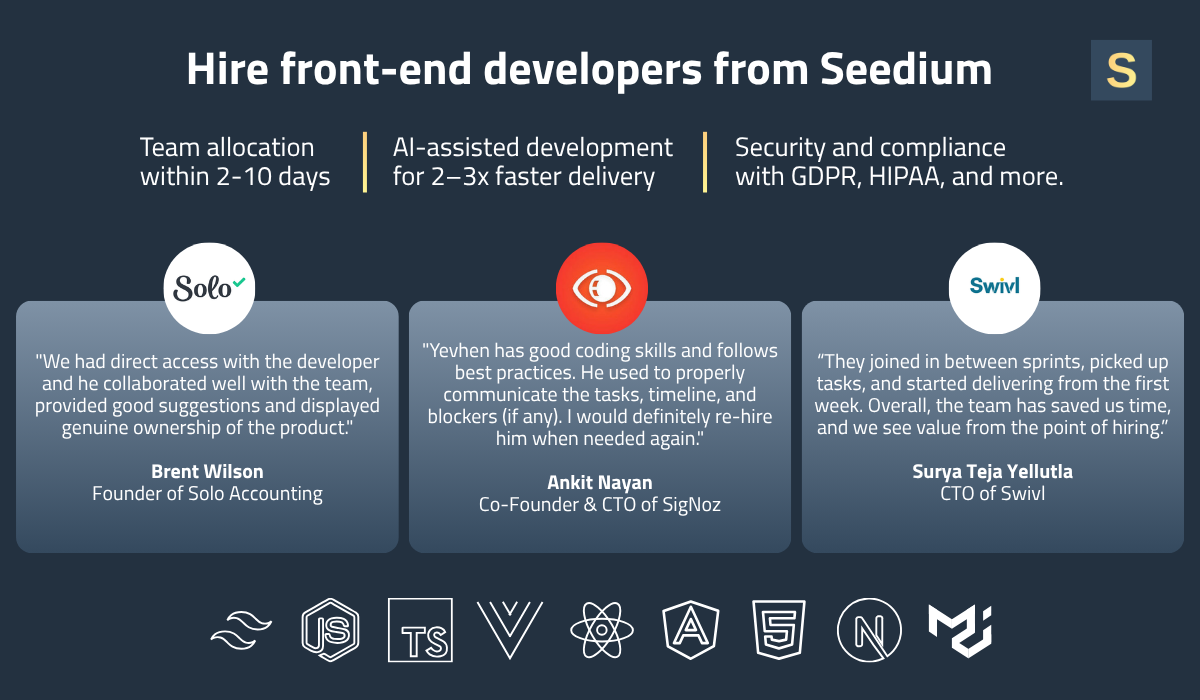
Success Stories for Hiring Remote Front-End Developers
We are proud that Seedium front-end developers contributed their expertise to the development and modernization of meaningful products in the global market. Check out some of them and learn how we provided value to our clients and helped them succeed.
Solo: Accounting Software for the Self-Employed
Our role: Seedium helped a fintech startup accelerate new feature development by providing expert team augmentation services.
Impact: The client was able to deliver a new feature to customers in 2 months while maintaining a high standard of quality and improving overall customer satisfaction.
Learn more about the Solo project.
SigNoz: Open-source observability tool
Our role: Seedium provided the client with top front-end talent, helping build and deliver a new product module within a 7-month collaboration.
Impact: The developed module improved visual clarity and, based on user feedback and usage data, helped reduce debugging time for SigNoz users.
Learn more about the SigNoz project.
Swivl: All-in-one app for field service businesses
Our role: Seedium helped modernize and scale a comprehensive suite of software tools for small and medium-sized businesses.
Impact: The solution was successfully delivered on schedule, covering both web and mobile platforms. The mobile app has since exceeded 1,000 downloads on Google Play.
Learn more about the Swivl project.


