


- The global SaaS market is projected to grow from $372.53B in 2025 to $1.35T by 2035, but growth rates are slowing compared to the 2020–2023 boom.
- AI adoption in SaaS is growing rapidly, creating both opportunities and challenges in the market.
- Predictable revenue growth, profitability, and data-driven insights are key focuses for SaaS providers to thrive in a maturing market.
The software-as-a-service market is projected to grow to $1.35 trillion by 2035, up from $372.53 billion in 2025, with North America accounting for the largest market share.
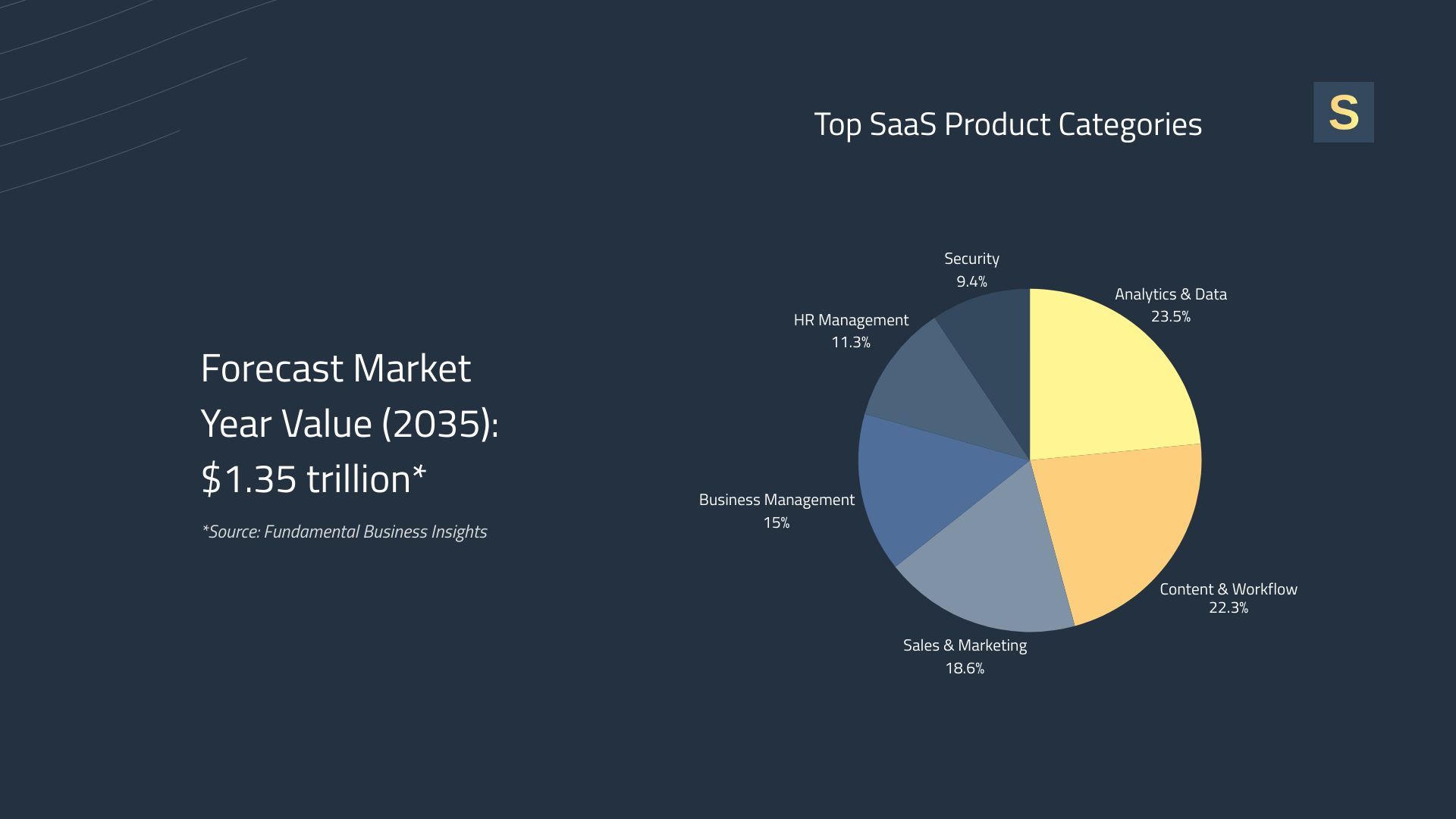
However, SaaS market growth rates seem to be leveling off compared to the rapid expansion of the 2020–2023 period.
The key reasons behind this include the following:
- Market saturation;
- Rising costs from higher hiring expenses;
- Complex team management;
- Increasing cloud infrastructure expenses;
- Fierce talent competition;
- AI disruption.
Despite slowing, the global SaaS market remains strong. SaaS providers adapt to changes while focusing on predictable revenue growth and profitability.
Key SaaS Market Highlights & Statistics 2026
The rapid advancement of AI and machine learning has become the primary force that drives SaaS trends. As organizations generate and collect huge volumes of data, the ability to efficiently process, analyze, and derive insights from it has become a critical competitive advantage. In 2025, this demand pushed Analytics & Data Management to the forefront of SaaS categories.
Let’s review the key market dynamics in more detail.
AI Creates New Challenges and Opportunities
Artificial Intelligence, especially large language models (LLMs), has become a double-edged sword for the SaaS market.
On the one hand, AI is replacing some traditional SaaS functionality, reducing the need for specialized tools. AI agents, in particular, promise multi-task solutions capable of performing a wide range of activities without requiring companies to invest in multiple standalone products or additional software licenses.
On the other hand, AI is also creating entirely new opportunities for SaaS growth. Developing, deploying, and operating AI systems requires robust infrastructure for data management, analytics, model monitoring, and integration. This demand is driving the rapid growth of new SaaS categories such as data, analytics, and AI-infrastructure products.
“Implementing AI agents at scale requires deep integration with multiple systems to ensure data consistency, security, and compliance. Additionally, AI agents often struggle with nuanced context, unpredictable exceptions, and user trust, making their deployment and adoption far more complex than established SaaS solutions.”
Mykola Stepanchenko, Data Scientist at Seedium
SaaS providers are increasingly integrating AI into their applications to keep up with user expectations. Against this backdrop, the AI SaaS market is projected to reach $85.7 billion by 2032, with a CAGR of 36.59%.
AI Becomes an Integral Part of Product Development
Advances in vibe-coding tools make it possible to develop prototypes and launch new features without large engineering teams or significant upfront investment. This democratization of software development has fueled a surge in micro-SaaS ventures, often created by solo founders. As a result, the global vibe-coding market is projected to grow rapidly, with estimates reaching $36.97 billion by 2032.
However, it’s important to realize the limitations of vibe coding. This approach is great for prototyping and MVP development, but falls short in scalability and maintainability. Founders increasingly report challenges such as performance bottlenecks, difficulty with extending functionality, limited control over security, and higher technical debt. That’s why teams engage professional developers to secure and stabilize their vibe-coded apps.
AI is also increasingly used in professional engineering as an assistant tool. According to the 2025 Stack Overflow survey, 82% of developers use AI tools daily or weekly. Engineers integrate AI to speed up testing, code generation, debugging, and knowledge retrieval.
Vertical SaaS Products Dominate the Market
Industry-specific workflows and compliance regulations create demand for vertical SaaS products. Founders of such solutions often come from the industries they serve, providing unique insights to create more effective applications.
Statistics indicate that investors are increasingly favoring vertical SaaS solutions. According to the Vertical SaaS Valuation Report for Q4 2025, vertical SaaS companies are commanding valuation multiples of 12x or higher, compared with roughly 5.2x for horizontal SaaS.
The global vertical SaaS market is expected to grow to $499.42 billion by 2035, driven by increased demand and investor confidence in niche markets.
Download the 2026 State of SaaS Report to Unlock More Insights
Unlock more SaaS market insights and strategies to adopt the key trends by downloading the 2026 State of SaaS Report. This report draws on the latest global industry research, expert insights from industry leaders, and Seedium’s practical experience gained from delivering more than 200 digital products.
Need support in building or modernizing your SaaS product? Feel free to check out our SaaS app development services.


